What a conversation with Deputy Head of Mission Ms. Dachtler taught us about bilateral diplomacy, Cold War memory, and the road into the German Foreign Service.
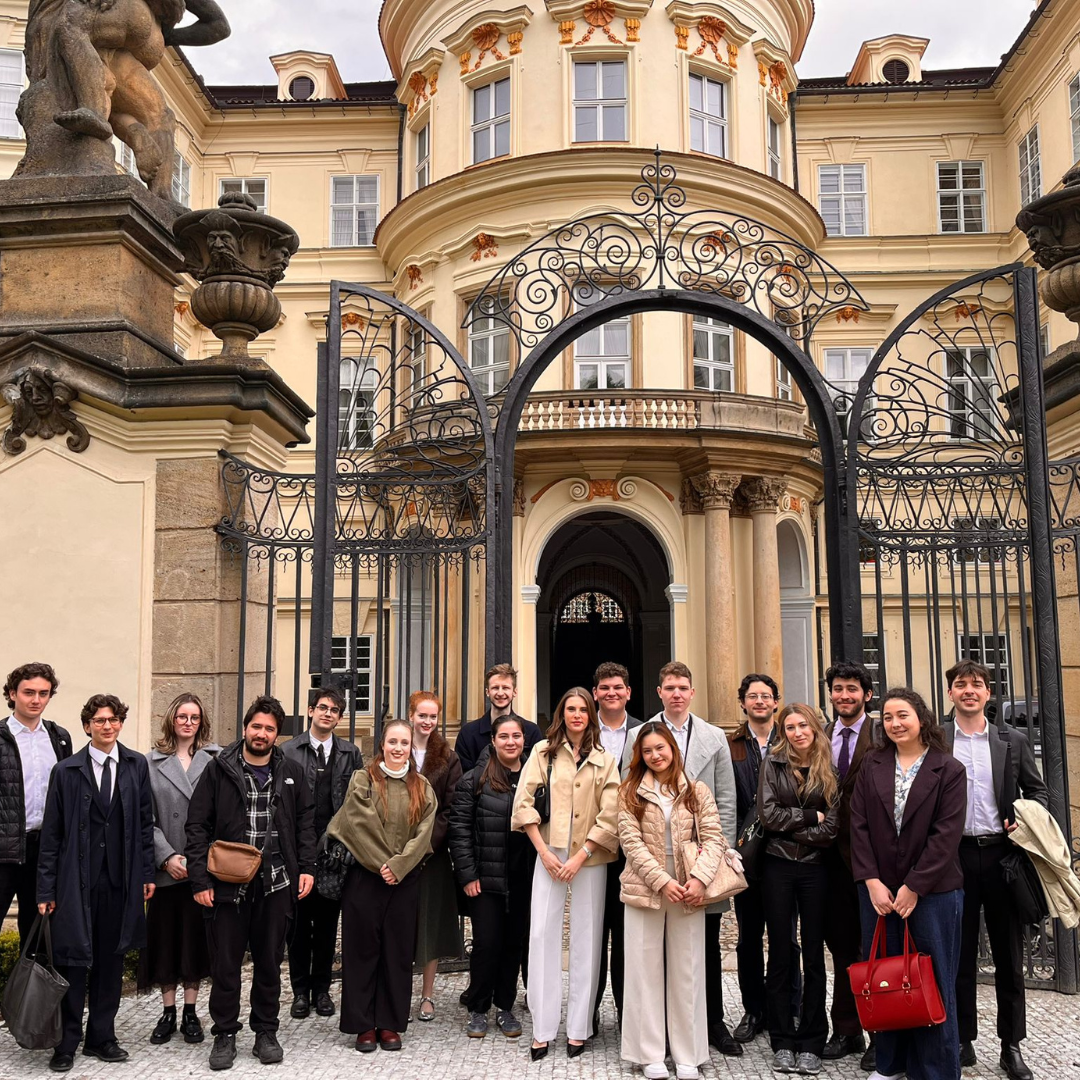
On April 21, twenty members of the Charles Diplomacy Society, representing fourteen different countries, gathered at the German Embassy in Prague for what proved to be one of the most rewarding institutional visits we have organised so far.
The building alone was enough to set the imagination running. The Embassy occupies a palace whose halls Beethoven once performed in, and that layered history is impossible to ignore. The most charged spot is what has come to be known as the Genscher Balcony, where in September 1989 Foreign Minister Hans-Dietrich Genscher addressed some four thousand East German refugees sheltering on the Embassy grounds, informing them they were free to leave for the West. Standing there, it is difficult to think of diplomacy as merely administrative work. Occasionally, it is the hinge on which history turns.#
Our conversation with Deputy Head of Mission Ms. Dachtler brought that sense of consequence into the present. She spoke with considerable frankness about the day-to-day realities of running a bilateral mission and was careful to distinguish it from the multilateral postings many of us more readily associate with diplomacy. Missions in Brussels or New York operate on a different logic: coalition-building, institutional process, bloc coordination. A bilateral mission like Prague is something else entirely. It is, above all, a relationship that is continuous, direct, and sensitive to every shift in the host country’s political weather.
Ms. Dachtler’s own career illustrated that point in personal terms. Returning to Prague for a second posting, something genuinely rare within the German diplomatic system, she brought both institutional memory and a renewed appreciation for what makes this particular relationship worth sustained attention. The mission’s partnerships reflect precisely that breadth: the German Chamber of Commerce, the Goethe-Institut, and the liaison offices of Germany’s federal states together sustain a wide portfolio of work spanning cultural events, public debates, market development, and the active promotion of Germany’s dual vocational education model abroad.
The conversation sharpened when it turned to the current state of the bilateral relationship. Ms. Dachtler did not paper over the disagreements. On defence spending and the energy transition, Berlin and Prague have at times moved in different directions, tensions that reflect genuine differences in strategic culture and economic interest rather than mere political noise. She was equally insistent, however, on the underlying solidity of the partnership. Germany and Czechia are constructing energy connectors along their shared border and have coordinated closely on Ukraine, including through the Czech ammunition procurement initiative. Disagreement, she suggested, is often a measure of how seriously two countries take each other.
The session closed with a detailed account of what it takes to enter the German diplomatic service, a subject that visibly engaged the room. The selection process runs across three distinct entry tracks and is deliberately demanding: candidates sit written examinations, oral interviews, and a psychological assessment before roughly forty are chosen each year to begin their training at the Academy of the Foreign Ministry in Berlin. The underlying philosophy is one of producing generalists, diplomats capable of representing German interests whether posted to Prague, Nairobi, or anywhere in between.
We are grateful to Ms. Dachtler and to the German Embassy for their generous welcome.